
Pregnancy comes with an overwhelming amount of advice. Take the hospital class. Watch YouTube. Hire a doula. And the classic: "You'll figure it out."
But too many parents reach labor and realize, mid-contraction, that they never truly understood how labor works or what their options were. Not because they didn't care, but because no one taught them in a way that stuck.
That gap is what a good childbirth class closes. In this guide, I'll walk you through whether birthing classes are worth it, when to take them, the types of classes available, and how to choose the right one for your birth.
Are Birthing Classes Worth It?
For most families, yes. Childbirth classes are not legally required, and plenty of babies have been born to parents who never took one. But "not required" is not the same as "not valuable." Here is what quality childbirth education actually gives you:
Less fear, more confidence. Learning the map of labor before you are in it makes the experience navigable instead of frightening.
Real decision-making power. Understanding the epidural, induction, and cesarean birth before they are offered lets you participate in those decisions.
A prepared partner. Partners who learn comfort measures and advocacy offer far better support than partners who are guessing.
Practical skills. Breathing practice, relaxation techniques, positions, and pain management techniques you can actually use.
Postpartum and newborn readiness. Good classes prepare you for recovery and early parenthood, not just the birth.
Are they worth the money? Compare the cost of a class (often $50 to $300) against what it prepares you for: one of the biggest physical and emotional events of your life. Measured that way, childbirth education is one of the least expensive, highest-impact investments of your whole pregnancy.
What about second-time parents? Experienced moms-to-be often skip the class, and many do fine. But a refresher is genuinely useful if your last birth was years ago, if you are planning a VBAC, or if your first birth did not go the way you hoped and you want more tools this time.
When to Take Birthing Classes
This is the question I hear most, so let's be specific.
The sweet spot: start around 28 to 32 weeks. That is roughly months 6 to 7 of pregnancy. Starting here gives you enough time to finish the material, practice the techniques, and revisit anything confusing before labor, while keeping it fresh in your memory.
How far in advance should you book? In-person classes, especially hospital classes, often fill up weeks ahead. Plan to register in your second trimester, around 20 to 24 weeks, even if the class itself starts later. Self-paced online courses can be started anytime.
Is 32 weeks too late? No. 32 weeks still leaves most families a solid six to eight weeks of learning and practice time. It is a completely reasonable starting point, especially with a self-paced course you can move through quickly.
How late is too late? Honestly, it is almost never "too late" to learn something useful. Even at 36 or 38 weeks, a condensed course or an online class you can watch in a weekend will leave you better prepared than walking in cold. Later starts simply mean less practice time, so prioritize the labor, comfort measures, and decision-making sections first.
Types of Birthing Classes Available
"Birthing class" covers several different philosophies and formats. Here are the main types, and who each fits best:
Lamaze class: The most widely known method. Focuses on breathing, movement, and relaxation techniques, with an evidence-based, "birth is normal" philosophy. A solid fit for almost any birth plan, medicated or unmedicated.
The Bradley Method: A 12-week, partner-coached approach centered on medication-free birth, nutrition, and deep relaxation. Best for committed couples planning a natural birth who want thorough, hands-on preparation together.
HypnoBirthing: Uses self-hypnosis, visualization, and deep breathing to reduce fear and tension in labor. A good match for mamas who are drawn to a calm, mindset-focused preparation.
Hospital-based classes: Taught at your delivery facility, often with a tour. Useful for learning that hospital's procedures, though often brief and policy-focused rather than comprehensive.
Online childbirth courses: Self-paced, on-demand education you take from home and revisit anytime. Ideal for busy schedules, rural families, bed rest, or anyone who wants depth without a fixed class time.
Cesarean preparation: For a planned C-section, look for a class or course section covering cesarean birth and recovery. Families planning vaginal birth benefit from this coverage too, since plans can change.
These are not mutually exclusive. Plenty of families take a comprehensive online course for the full education and add a hospital class for the facility tour.
What a Good Childbirth Class Covers
Whatever format you choose, a comprehensive class should prepare you for the whole arc, not just the pushing. Look for coverage of:
Pregnancy and prenatal health: what is normal, nutrition, movement, and choosing your provider (midwife, OB-GYN, birth center, or hospital)
Labor itself: the stages of labor, signs labor is beginning, contractions, and when to call your provider
Comfort measures: breathing practice, position changes, massage, counter pressure, and how your partner helps
Medical options: a balanced look at the epidural, induction, monitoring, and cesarean birth, framed through informed consent
Unexpected turns: preparing for a changed birth plan, a long labor, or a NICU stay, so you keep your voice when things shift
The fourth trimester: postpartum recovery, mental health, breastfeeding basics, and newborn care
If a class only covers labor, it is doing half the job. The weeks after birth deserve as much preparation as the birth itself.
How to Choose the Right Birthing Class
With the types in mind, run any class you are considering through these questions:
Does it match your birth goals? Planning an unmedicated birth? Bradley or HypnoBirthing may fit. Want balanced preparation for any path? Lamaze or a comprehensive online course serves you better.
Who teaches it? Look for an experienced, credentialed birth professional: a midwife, certified childbirth educator, or experienced doula.
Is it evidence-based? Current, credible guidance, not one person's opinions.
Does the format fit your life? In-person classes offer hands-on practice and community. Self-paced online courses offer flexibility and replay access. Neither is universally better.
Does it include postpartum, breastfeeding, and newborn care? These are too important to skip.
Can your partner participate fully? The best classes teach partners real skills, not just attendance.
Finding a Class Near You
For in-person options, start with your hospital or birth center's class calendar, ask your midwife or OB for recommendations, or search the Lamaze and Bradley Method directories for certified local instructors. Local doulas also know which nearby classes families love. If nothing nearby fits, a quality online course removes geography from the equation entirely.
Other Classes to Take Before Giving Birth
Childbirth education is the core, but a few companion classes round out your preparation for parenthood:
Breastfeeding class: Learning to breastfeed before your baby arrives makes an enormous difference. A good class covers latch, feeding cues, milk supply, and when to call a lactation consultant.
Newborn and infant care: Diapering, bathing, safe sleep, soothing, and what normal infant behavior looks like. Especially valuable for first-time parents who have never handled a newborn.
Infant CPR and safety: A short, hands-on class every parent and grandparent should take.
Postpartum preparation: Some families add a class or course section on recovery, mental health, and the realities of early parenthood, and it pays off in those first weeks.
Many comprehensive courses bundle several of these together, which is often the most practical route.
Why Many Parents Choose a Midwife-Led Course
To be clear: this is not midwives versus OBs. Obstetricians are essential, and many families choose OB care and have wonderful births. What midwife-led education emphasizes is the physiology of birth: how the process is designed to unfold and what normal looks like across a wide range. That lens shapes the teaching toward shared decision making and personal empowerment, and it pairs beautifully with any kind of medical care, including OB and hospital birth.
A Course That Checks Every Box
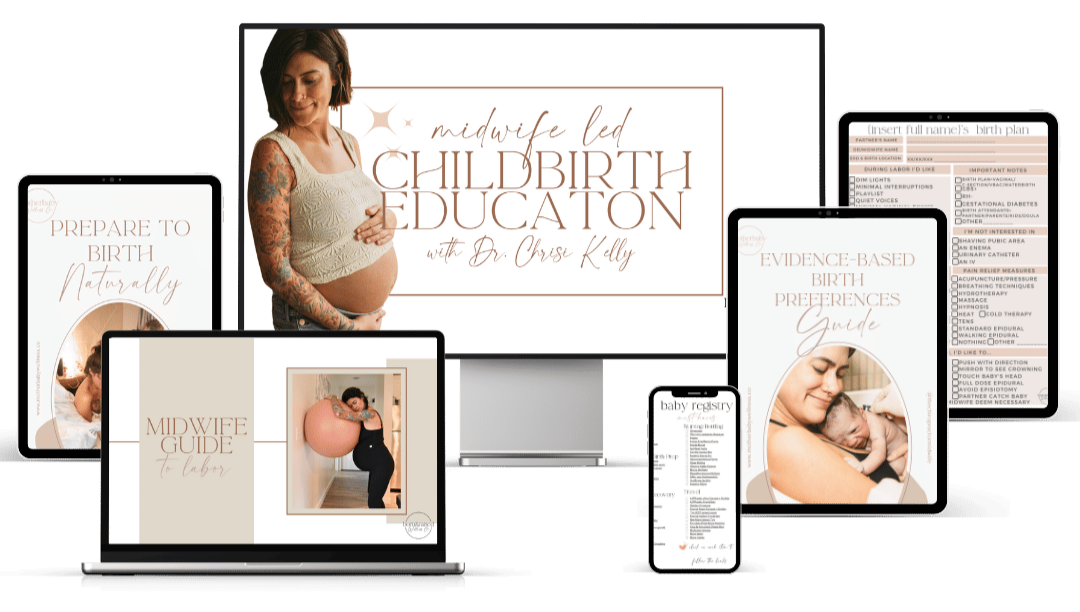
Families ask me for a recommendation constantly, so here is mine. I built our online birth course to be exactly the comprehensive, evidence-based, midwife-led education this guide describes: the full arc from pregnancy through labor, comfort measures, medical options, postpartum recovery, breastfeeding, and newborn care, self-paced with lifetime replay access, plus printable resources including a customizable birth plan and labor guides.
Written by Dr. Kelly — perinatal and pediatric chiropractor, ICPA Webster Certified, Certified Professional Midwife, and certified BRM® Pro.
Frequently Asked Questions
Are childbirth classes really necessary?
They are not required, but they are one of the highest-value preparations available. Families who take a quality class report less fear, better communication with their care team, more confident partners, and a smoother start to postpartum. If you skip everything else, at minimum learn the stages of labor, comfort measures, and your medical options before your due date.
What week should you start birthing classes?
Around 28 to 32 weeks is ideal for most families, roughly months 6 to 7. That leaves time to finish the material, practice the techniques, and revisit sections before labor while everything stays fresh. Register earlier (20 to 24 weeks) for in-person classes, which can fill up ahead of time.
Is 32 weeks too late for a birthing class?
Not at all. Starting at 32 weeks still gives you six to eight weeks to learn and practice, which is plenty. Even starting at 36 weeks or later, a condensed or self-paced online course leaves you meaningfully better prepared than no class at all. Prioritize the labor, comfort measures, and decision-making sections first if time is short.
What classes should I take before giving birth?
A comprehensive childbirth class is the foundation. Beyond that, the most valuable additions are a breastfeeding class, a newborn or infant care class, and infant CPR. Many families also benefit from postpartum preparation. Comprehensive online courses often bundle several of these together, which is the most practical route for busy parents-to-be.
What is the 5-5-5 rule for childbirth?
The 5-5-5 rule is a postpartum recovery guideline: 5 days in bed, 5 days on the bed, and 5 days near the bed, roughly the first 15 days after birth spent prioritizing rest and healing over housework and visitors. (It's different from the 5-1-1 rule for heading to your birth location: contractions 5 minutes apart, lasting 1 minute, for 1 hour.)
Which type of birthing class is best for a natural birth?
The Bradley Method (partner-coached, 12 weeks, medication-free focus) and HypnoBirthing (self-hypnosis and deep relaxation) are the two classes most specifically built for unmedicated birth. Lamaze also supports natural birth well while keeping all options open. A comprehensive midwife-led course covers natural comfort measures alongside balanced information about medical options.
Can my partner take the class with me?
Yes, and they should. Most quality classes are designed for couples, and some, like the partner-coached Bradley Method, are built entirely around it. Partners who learn comfort techniques, communication, and advocacy in advance offer far better support during labor and feel far more confident themselves.
Do childbirth classes replace my prenatal appointments?
No. Your prenatal appointments monitor your health and your baby's, while a childbirth class teaches you how labor works and helps you prepare for decisions. The two work together, and a good class will send you back to your provider with better questions.
Feeling Informed Is the Goal
Every birth unfolds differently. No class can promise a particular experience or erase the uncertainty that is part of bringing a baby into the world. What good childbirth education does is help you feel informed, confident, and ready to make decisions that are truly yours, through pregnancy, labor, birth, and early parenthood.
Start in the window that works for you (28 to 32 weeks is the sweet spot, and later still counts), choose the type that fits your birth goals, and add the breastfeeding and infant care pieces that round out the picture. The fact that you are preparing at all means you are already doing right by your baby.
Explore our midwife-led online birth course →
Learn about prenatal chiropractic care →
Always discuss medical decisions with your own healthcare provider. This article is educational and not a substitute for individualized medical advice.