
Figgy vs Nugget: A Family Chiropractor Compares the Two Play Couches
If you have spent any time researching play couches, you have run into the same two names again and again: the Nugget and the Figgy. They pop up in every parenting forum, every TikTok "playroom must-have" video, and every Nugget alternative thread. So which one is actually worth your money?
I don’t review products often, but the Figgy play couch has been in our home long enough and used hard enough for me to give an honest, expert take. This is not a sponsored post; it’s a chiropractor and mom comparing two play couches, what held up, and which one fits which family.
- Figgy vs Nugget: the quick answer
- Where each play couch came from
- Feature-by-feature
- Side-by-side
- Figgy play couch pros and cons
- Other nugget alternatives worth knowing
- Why this matters from a chiropractic perspective
- Frequently asked questions
Figgy vs Nugget: the quick answer
A note on links: This post contains affiliate links. If you make a purchase through one, we may earn a small commission at no extra cost to you. We only recommend products we genuinely use and trust.
Here is the short version, if you are in a hurry.
Choose the Nugget if your top priority is the lowest price, you want the widest range of colors, and your kids are gentler toddlers who will not be stress-testing the connection system every day.
Choose the Figgy if you want verified non-toxic materials, a connection system built to survive active climbing, furniture-grade fabric, and a play sofa that grows with your child from toddler years into school-age. It costs more upfront, but it is the one I recommend for most families.

Dr. Kelly’s sons playing on the Figgy play couch.
Now, the details.
Where each play couch came from
This origin story matters more than you would think.
The Nugget was the original modern play couch, launched through Kickstarter. Here is the part most parents do not know: it was originally designed as a dorm room couch, not a children's product. It became a kid favorite almost by accident, once families discovered how well the foam-filled pieces worked for building and climbing.
The Figgy came later, also through Kickstarter, but it was designed from day one by a product engineer and mother of six specifically for kids' imaginative play. That difference shows up everywhere: in the connection system, the fabric, and the way the whole thing is built to be rebuilt a thousand times.
Feature-by-feature: Figgy vs Nugget
Cushions and foam
Both couches come as a four-piece base set: two large base cushions and two smaller pillows or wedges that stack, fold, and rearrange. The Nugget base cushions are slightly thicker than the Figgy's 4.5-inch base pieces, which some families prefer for a plusher seat. The Figgy trades a little of that thickness for firmer, higher-density foam that holds a built structure more reliably under a climbing kid.
The practical difference: softer, thicker foam feels cozier for lounging, while firmer, high-density foam is better for building forts and towers that need to stay standing. Both couches ship vacuum-sealed and compressed, then expand once you unbox them, though the Figgy's FiggyFoam is CertiPUR-US certified and made in the United States, which matters for the next point.
Connection system: the biggest difference
This is where the two play couches genuinely diverge. The Nugget uses friction and the weight of the pieces to hold a build together. It works fine for gentle play, but active kids can knock a fort apart pretty easily.
The Figgy uses a patent-pending Velcro attachment system. Independent testers watched kids climb and sit on Figgy structures and found the pieces held firm without collapsing, while still being easy for an adult to pull apart and rebuild. If your kids are the type to launch themselves at a fort at full speed, this is the single most important difference between the two.
Fabric and cleaning
Both couches have machine-washable covers, which is essential with young kids and daily spills. Covers unzip from the foam and go straight into your home washing machine.
The Figgy's higher-end fabric lines, like the Luxe Velvet and double-brushed microsuede, have been described by independent reviewers as closer to furniture-grade upholstery, with water-repellent, stain-resistant finishes and reinforced seams. For families with toddlers, potty training, or frequent spills, Figgy also offers optional waterproof liners that fit under the covers for extra leak protection. The Nugget wins on color variety, with a rotating lineup that changes seasonally.
Safety and non-toxic certifications
Both brands market themselves as non-toxic, but the paper trail differs. Figgy publishes independent, third-party lab testing on every component and holds CertiPUR-US certified foam plus GREENGUARD Gold certified fabric across every color option, with OEKO-TEX Standard 100 on select fabrics. Its foam emits less than 0.5 parts per million in VOCs, a very low figure for indoor air quality.
As a chiropractor, this matters to me because kids press their faces into these cushions for hours. If you would demand a certain standard for a crib mattress, it is reasonable to want that same verification in a play couch made from foam-filled cushions and fabric your child breathes against daily. Figgy's documentation is more specific and more thoroughly verified than most competitors in this space.
Versatility and builds
Both couches support open-ended, imaginative play: forts, ramps, reading nooks, and pretend spaces. The Figgy's Velcro system makes certain builds more stable and ambitious. A few our kids build constantly:
- The bridge: two base pieces spanned by the flat cushions, sturdy enough to crawl under and climb over, because the Velcro keeps the span from sliding apart.
- The tower: stacked pieces that stay stacked, so a toddler can climb without the whole thing shifting sideways.
- The obstacle course: pieces spread across the room as stepping stones and jumps, then reconfigured into a slide.
Figgy's expansion ecosystem also goes further than the Nugget's: wedge pillows, an adventure mat, and even play kitchen panels that turn the base couch into a pretend kitchen. It is a system that keeps evolving as your child grows.
Price and value
The Nugget is the more budget-friendly of the two, which is a big part of why so many parents look for a "Nugget alternative" in the first place. The Figgy runs higher, starting around $385 for the base set and climbing with fabric upgrades and add-ons.
Here is how I think about the cost: spread across years of daily, high-impact use and backed by a 10-year warranty, the Figgy's cost-per-year of play is genuinely reasonable. Premium modular play couches also tend to hold strong resale value, so a well-kept Figgy recoups a meaningful chunk of its cost if you ever sell it. That is not something you can say about most kids' furniture.
Figgy vs Nugget: side-by-side
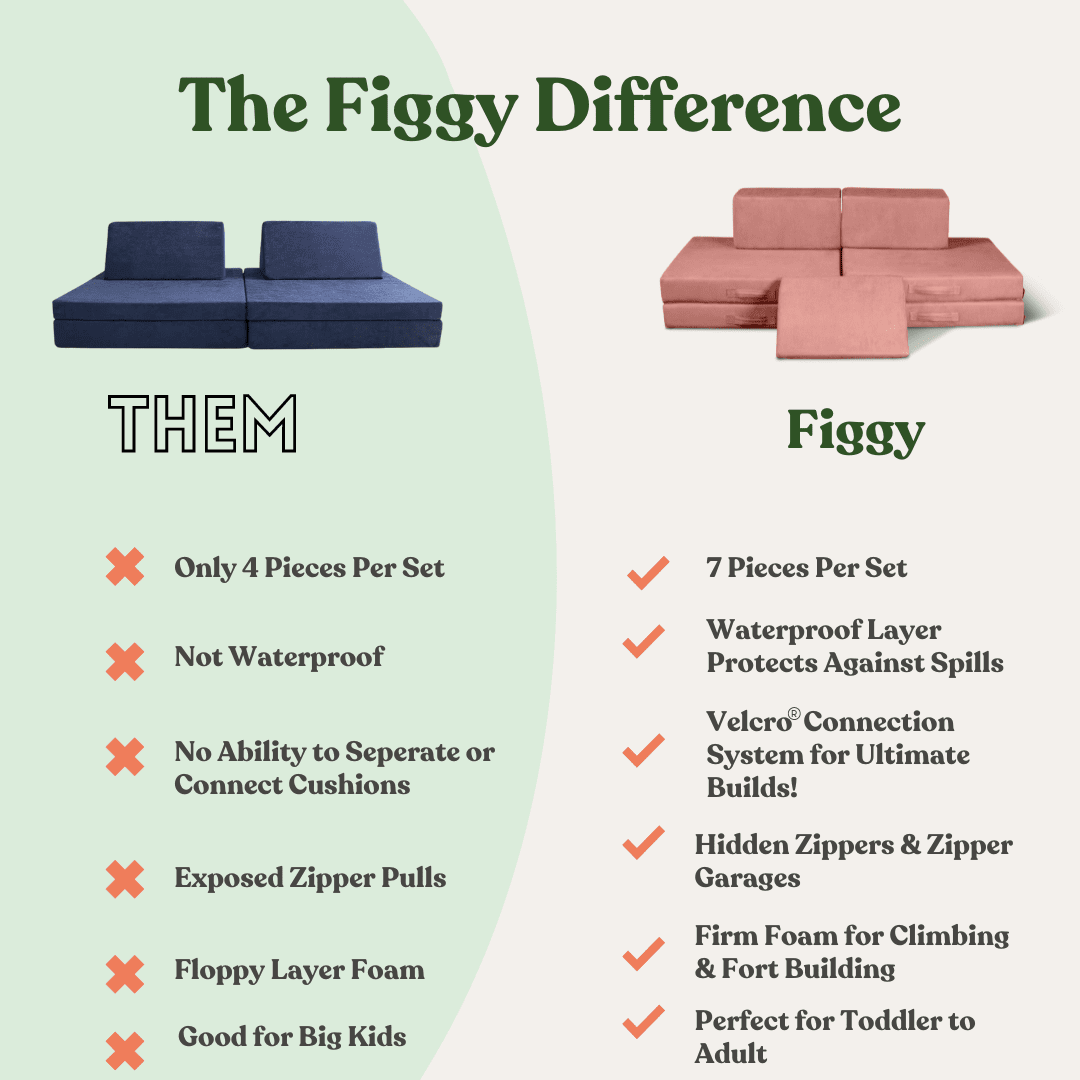
Connection system: Figgy uses patent-pending Velcro (holds firm under climbing); Nugget uses friction and weight (fine for gentle play).
Foam: Nugget base is slightly thicker and plusher; Figgy is firmer, higher-density, CertiPUR-US certified, made in USA.
Fabric: Figgy offers furniture-grade Luxe Velvet and microsuede with stain-resistant finishes; Nugget offers more color variety.
Certifications: Figgy publishes third-party testing, GREENGUARD Gold, OEKO-TEX; both market as non-toxic.
Cleaning: Both machine-washable; Figgy adds optional waterproof liners.
Warranty: Figgy 10-year; Nugget 1-year.
Price: Nugget lower upfront; Figgy higher but strong resale value.
Other Nugget alternatives worth knowing
Figgy and Nugget are not the only players. If you are weighing Nugget couch alternatives more broadly, a few other brands come up often:
Yourigami is a fold-flat play couch sold at Costco, popular for small spaces because it collapses for storage. Foamnasium makes soft foam play furniture aimed at younger toddlers and playrooms. Brentwood Home and Barumba also make modular play sofas at various price points. Each has trade-offs, but for the specific combination of durability, verified safety, and long-term play value, Figgy remains my top pick among the Nugget alternatives I have looked at.
Why this matters from a chiropractic perspective
A play couch is not just a toy. It is a tool for the kind of climbing, building, and full-body movement that genuinely supports healthy development in early childhood.
When kids stack, climb, and crash on a play couch, they are building core strength and training the vestibular and proprioceptive systems: the body's sense of balance and where it is in space. Specific movements matter here. Crawling over a foam bridge builds bilateral coordination, the ability to use both sides of the body together. Twisting to climb a tower develops trunk rotation. Jumping between pieces builds the postural control that supports everything from sitting still at school to riding a bike later on.
This is why the connection system matters so much to me. A couch that stays put under active play invites bigger, braver movement. A couch that collapses teaches kids to play tentatively. For that reason, the Figgy's stability gives it a real edge for the kind of developmentally rich play I want to see.
Frequently asked questions
Is Figgy or Nugget better?
It depends on your family. The Nugget is more budget-friendly, plusher, and comes in more colors, which suits gentler toddler play. The Figgy has a patent-pending Velcro connection system that holds firm under active climbing, furniture-grade fabric, verified non-toxic certifications, and a 10-year warranty. For durability, safety documentation, and long-term play value, Figgy is the stronger choice for most families.
What is the main difference between Figgy and Nugget?
The connection system. The Nugget holds together by friction and the weight of its pieces, while the Figgy uses a patent-pending Velcro system that keeps builds standing under active climbing. The Nugget's base cushions are slightly thicker and plusher; the Figgy's foam is firmer and higher-density, which holds forts and towers together better.
What are the best Nugget alternatives?
The Figgy is the closest premium alternative, with better durability and verified safety certifications. Other Nugget alternatives include Yourigami (a fold-flat option sold at Costco, good for small spaces), Foamnasium (soft foam furniture for younger toddlers), and modular play sofas from Brentwood Home and Barumba. For long-term value and safety, Figgy is my top pick.
Is the Figgy play couch worth the price?
For families who value verified non-toxic materials and long-term durability, yes. Starting around $385, it is backed by a 10-year warranty, independently lab-tested components, and furniture-grade fabric. Spread across years of daily use, the cost-per-year is reasonable, and premium modular play couches like the Figgy tend to hold strong resale value.
Are Figgy and Nugget covers machine-washable?
Yes. Both brands have covers that unzip from the foam and are machine-washable in a standard home washing machine. The Figgy also offers optional waterproof liners that fit underneath the covers for extra spill and leak protection, which is especially useful for younger toddlers or households prone to accidents.
Curious how nervous system health connects to physical development in the early years? Learn about our pediatric chiropractic care →
Book a visit with Dr. Kelly at MotherBaby Wellness →
Reviewed by Dr. Kelly, perinatal and pediatric chiropractor, ICPA Webster Certified, and Certified Professional Midwife, serving families in the Twin Cities, MN.
Sources
- The Figgy Play Couch – Figgy
- Figgy Play Couch Quality: Foam, Fabric & Safety Certifications – Figgy
- The Figgy Review – Play Couch Reviews